Tumaini
Digital trust and safer decisions
An existing research prototype that checks voice notes and payment requests before someone acts on them, and holds a payment until an independently registered contact confirms it.
A working prototype can be demonstrated. It has not published peer-reviewed results, and it is not an official banking or government service.
What this project is.
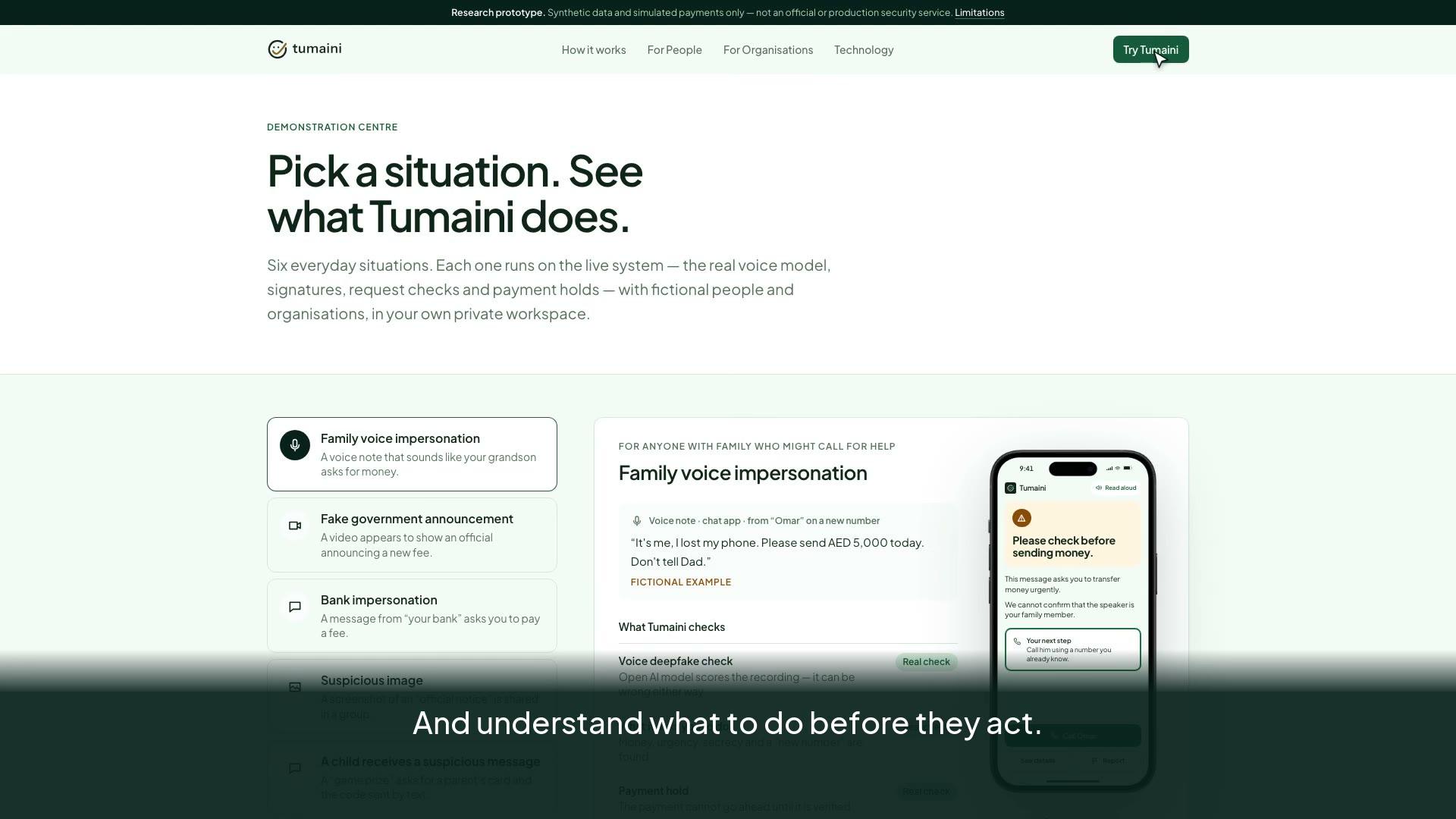
Tumaini began with a narrow, difficult problem: a voice note can sound exactly like someone you trust and still be manufactured. Detectors trail new tools, are trained mostly on a handful of languages, and return scores people cannot act on in the moment.
The prototype takes a different route. It checks a voice note with an open anti-spoofing model, explains what the message is asking for in plain Arabic or English, and then places any requested payment in a protected state. The release requires a contact the person registered before the message arrived, or a signed receipt from the institution that matches that exact payment.
For Mathenge Research, Tumaini is a foundation rather than a finished argument. It gives us a concrete system in which to study model limitations, provenance, uncertainty, institutional verification and how people respond to a warning they did not ask for.
What we want to find out.
- 01Where does an audio detector fail on regional dialects and modern voice cloning, and how should that uncertainty be shown to a non-specialist?
- 02Can signed receipts and independently confirmed contacts reduce reliance on a detector without creating a new single point of trust?
- 03How do people act on an inconclusive warning when the message is emotionally urgent?
- 04What evidence would an institution, a regulator or a court actually accept, and what should be retained to produce it?
- 05Which parts of the verification path can be reproduced by an outside researcher from public material?
How the work is approached, where it has been established.
These methods describe what exists or what has been written down. They are not a claim that a full evaluation has been completed.
- Documented threat model and decision path, including what the system deliberately does not decide.
- Audio analysis with an open anti-spoofing model, with an explicit inconclusive band rather than a binary verdict.
- Request understanding that surfaces payment, code, link and deadline, plus pressure cues such as urgency or secrecy.
- Payment hold enforced in both the API and the database, released only by a registered contact or a matching signed receipt.
- Signed evidence reports and a hash-chained audit log so a case can be reviewed afterwards.
What this work does not do.
- 01Images and video receive Content Credential checks only. The prototype does not yet judge whether a photo or clip has been manipulated.
- 02Arabic results come from one public dataset of Levantine voice conversions. No claim is made about general Arabic accuracy, and modern voice clones and Gulf dialects were not tested.
- 03Payments and message delivery are simulated. The prototype does not move real funds or send real messages.
- 04There is no pilot partner, bank or government endorsement. Tumaini is a research prototype built for the UAE Hackathon 2026.
- 05A valid signature shows where a message came from and that it has not changed. It does not prove that the message is true.
A project improves when someone outside it looks closely.
We would welcome conversations with researchers working on audio authenticity, provenance and human factors, and with institutions willing to examine what verifiable communication should look like.
Other projects in the registry.
Document intelligence
Multilingual Document Intelligence
A proposed research direction on how small, efficient systems handle real documents across languages, formats and constrained hardware.
Read the projectLanguages and context
Language and Context Evaluation
An exploratory direction on multilingual evaluation, regional speech, code-switching and the expertise required to judge an answer fairly.
Read the project